**Disclaimer**: This blog post is not made to offend anyone. It is only here to have the readers reflect, think, and start a discussion. If there are any historical inaccuracies, let me know!
Anyways, let's get on with it! What makes a villain?
In Grendel's case, he was ostracized by his society and went on a murderous rampage, killing countless men, women, and children, every night for twelve years. SOMETHING must have pissed him off in order to pull that off. He was also Beowulf's first antagonist. Oh, and let's not forget he was practically cursed at birth just because he was a descendant of Cain. Sounds like villainous behavior to me.
Now, some may read that paragraph above and sympathize with Grendel. Grendel has fans! Some may say that Grendel is misunderstood; maybe he has a grudge and his crimes can be forgiven because of something that had happened to him in his past. Well, it's also not his fault who his ancestors were; he was screwed from the beginning!
So, how can we take what we know of Grendel and relate it to current events? Does Grendel sound like anyone we learned about in history? And if so, would you still be rooting for him?
The one person that came to mind when I thought of Grendel was.... Adolf Hitler.
.
WHAT!?!? OH, NO SHE DIDN'T!!
.
Yes. Yes, I did.
Classmate #1: "But.. uh.. Grendel didn't have millions of people supporting him."
Classmate #2: "He's also a fictional character, so don't take this so seriously"
Classmate #3: "I still can't believe you said Hitler."
Believe it.
Now, I'm not saying Grendel is Hitler. I'm saying the behavior is pretty much the same. Hitler, before his rise to fame, was ostracized from his society. He was just a grunt soldier in the German Army with big ideas and no one to back him up. He even went to jail for five years!
Villainous Trait #1: Ostracized from society? Check!
Hitler held a mean grudge. He blamed Jews, homosexuals, pretty much everyone for Germany's fall after the Treaty of Versailles. With that grudge, he decided to fix Germany's "Jew" problem and exterminate them.
Villainous Trait #2: Murderous Rampage? Check!
Now, if you factor in historical rumor, gossip, and maybe some fact: His mother being a Jew, and Hitler himself being a homosexual, that might be cause for him to get pissed about who he became due to his parents. He was also one of the world's biggest antagonists. Every country in the world (except for Hitler's allies) hated this guy.
Villainous Trait #3: Cursed Parentage and Huge Antagonist for the World? Check and Check!
Grendel didn't have fans the way Hitler did. To our knowledge, he wasn't as charismatic, he didn't write a book, and he wasn't even in a position of power. He had his mother, probably his ONLY fan. But, even if you have one person supporting you, don't you feel like you could take on whatever you set your mind to? You may feel like the world is against you, but if you call up your Mom/Dad/Grandpa/etc. etc. they can quickly change how you feel about the world and yourself. So, yes, Grendel didn't have millions of fans, but he did have one. Hitler probably started out with one, as well. Hitler offered a new Germany and his fans were so desperate that they didn't care how they obtained it. Can you blame them? Whose to say that if Grendel went to the next town over, he wouldn't have gained some support?
We see this recurring throughout history even today! Any terrorist group in the world probably had a leader that started out just like Hitler. All having a dream and willing to do the unthinkable to attain it.
- Al Qaeda - Boko Haram - ISIS
So the question I'm posing to all of you guys is: Do you still support Grendel? If so, why? Are there any other similarities/differences I didn't mention that you think should be addressed? Do you agree with me or am I totally wrong? Let's open up the comments section to a great discussion!
Sunday, September 13, 2015

Friday, September 11, 2015
Heroes or Zeros?
I was never really into superheroes as a child. Yeah, I saw "Hercules" a few times growing up, but it was not a movie that was I obsessed with or anything. In fact, it was one of my least favorite Disney movies. As a kid, I could not really pinpoint why I did not like Hercules very much. Now that I am older, and especially since I just read "Beowulf", I am kind of starting to see why I had a problem with it. These two guys, Hercules and Beowulf, their characters are so....unattainable.
Hercules made it look so easy to go from the scrawny little guy to this buff Greek demigod. Beowulf swam for seven days in armor without taking a breathe. That is crazy! I can understand why people like the larger-than-life figures. Beowulf was loved by his people and his story has lasted hundreds of years. Hercules, well, this song can explain how famous he got better than I can!
I think one of the biggest issues that I have with these two characters is their arrogance. Hercules thinks that just because he has beaten off all of these villains and he has his own action figure that he deserves a place on Mount Olympus. Beowulf, while he does not think he is a god, he is very proud. He tries to slay a dragon by himself in his very old age. Now what about that sounds like a good idea?
I think the one time I was really able to sympathize with Beowulf was when he was losing and Wiglaf had to come to his aide. That had to be a really big reality check for him because he was able to get by on his own for most of his life. It was such a human moment for Beowulf. Granted, it came really late in the story, but it was still a very interesting moment. For me, Beowulf was one of those stories that I enjoyed reading, but I have a hard time pinpointing a character that I actually like. It is kind of conflicting to feel this way!
Now, I am not completely a cynic when it comes to superheroes. While I do think that many of them tend to have overinflated egos, I think there is a lot of good that comes out of them. Not the good deeds that they go around doing in the comic books, I'm talking about the good things that happen as a result of them in everyday life. Stories like "Beowulf" and "Hercules" can provide people with an escape, all stories like this can. There are a lot of crappy things that happen in the world, the news makes a point to remind us every day. Superheroes serve as a reminder that there are good people and it can be very comforting. Look at that guy who went around to hospitals dressed as Batman in order to cheer up sick children. Stuff like that makes me really happy that we have superheroes in the world. Like Phil says to Hercules "To be a true hero, kid, is a dying art/ Like painting a masterpiece, it's a work of heart". Anyway, these are just my thoughts.
Hercules made it look so easy to go from the scrawny little guy to this buff Greek demigod. Beowulf swam for seven days in armor without taking a breathe. That is crazy! I can understand why people like the larger-than-life figures. Beowulf was loved by his people and his story has lasted hundreds of years. Hercules, well, this song can explain how famous he got better than I can!
I think the one time I was really able to sympathize with Beowulf was when he was losing and Wiglaf had to come to his aide. That had to be a really big reality check for him because he was able to get by on his own for most of his life. It was such a human moment for Beowulf. Granted, it came really late in the story, but it was still a very interesting moment. For me, Beowulf was one of those stories that I enjoyed reading, but I have a hard time pinpointing a character that I actually like. It is kind of conflicting to feel this way!
Now, I am not completely a cynic when it comes to superheroes. While I do think that many of them tend to have overinflated egos, I think there is a lot of good that comes out of them. Not the good deeds that they go around doing in the comic books, I'm talking about the good things that happen as a result of them in everyday life. Stories like "Beowulf" and "Hercules" can provide people with an escape, all stories like this can. There are a lot of crappy things that happen in the world, the news makes a point to remind us every day. Superheroes serve as a reminder that there are good people and it can be very comforting. Look at that guy who went around to hospitals dressed as Batman in order to cheer up sick children. Stuff like that makes me really happy that we have superheroes in the world. Like Phil says to Hercules "To be a true hero, kid, is a dying art/ Like painting a masterpiece, it's a work of heart". Anyway, these are just my thoughts.
Wednesday, September 2, 2015
Home and Family
On the first day of this class I was taken by surprise when I was asked to think about what England meant to me and what it represented. I’m actually from England, my parents moved to Pennsylvania when I was around two years old. We have no family or history over here and that has led to a sense of placeless-ness I am forced to examine now. My family, even though we were trying desperately to fit in, did not at all. We raised chickens in our backyard, had huge bonfires, and I basically grew up in the woods behind our house. To the dismay of our neighbors I would invite their kids to come and have adventures in the woods with me where we would come back covered in mud and sometimes a little blood. Anyway, this has nothing to do with Beowulf YET but it will don’t worry. But it’s strange, England does not feel like home even though I’ve returned many times and neither does Bucks County Pennsylvania. Even while growing up I thought of it as a very temporary place to me. Okay enough existential garbage.
Every time I read Beowulf I always end up rooting for Grendel. Actually thats a lie, from the very start I am rooting for Grendel. I think it is because all of the kings and danes and beowulf are characterized to be perfect heroes and that's boring. But being a horrible demon descended from Cain is something I can get behind. I am also always fascinated by Grendel's mother who is described to be even more horrible than Grendel. Why have Grendel's family be a matriarch in this land of patriarchs? Would the story change if it had been Grendel's father Beowulf had to eventually fight? This is an interesting choice I want to discuss. It’s astonishing Grendel is given any family at all, it would have made him even more alienated from society if he did not because family ties and lineage matter so much in this land. One of the questions from the content reading I would like to answer is “To what extent are we still judged by our family and/or our friends today?” I’ve been thinking about this a lot lately in general, and the answer is a lot! Humans are pack animals and rejection from other humans can be the equivalent of death in the human brain (let me know if you want a source I’ll find one!). This is why the Mead Hall was built and community is so important in this land (and today) and I think that’s why I alway root for Grendel. He didn’t have any of that! He had no community and maybe all of us inserted into Grendel's experience and isolation would not act dissimilarly.
Tuesday, September 1, 2015
Bravery vs. Fearlessness
When I was in high school, one of the
major literary works that we read was Beowulf.
Now, I’ll be honest: I did not like it one bit. Poetry has never been my forte,
and seeing an entire book made out of it made me squirm. Its language was way
too difficult for me to understand and, frankly, from what I did understand,
Beowulf was an egotistical superhuman whose most used power was vanity. However,
I will admit that perhaps I did not give Beowulf
the chance it deserved a few years back.
Upon
rereading it, I found myself actually enjoying the pace and language of the
story. Since high school, I have become more involved with poetry and while it
is still not my strong suit, I have a deeper appreciation for the art. With
that said, I must continue to support my previous statement of Beowulf being egotistical.
Throughout
the book, Beowulf is regarded, except for a select few, as a great hero who is
courageous, strong, and brave. He is boastful about his past achievements, believing
that he can do anything, beat any foe who comes his way. He is fearless. And it
is at this point that a red flag is raised in my mind.
Is Beowulf
truly brave?
Bravery
to me is facing your fears. It is jumping head first into something even though
you are scared. Fearlessness is exactly as it sounds; one does not have
anything to fear. Therefore, if Beowulf is fearless, as he certainly seems to
be when boasting about his past victories and his decision to fight Grendel not
only without his sword and shield but completely naked of any sort of armor, it
is difficult to prove that he is also brave.
When
I think brave, I think of Helen Keller who, despite her disabilities of being
both deaf and blind, dedicated her life to improving the world’s view and
treatment of deaf people; Martin Luther King, Jr., who was part of the Civil
Rights Movement and lead the fight against racial discrimination; and, Mother
Theresa, who dedicated her life to helping the unfortunate in Calcutta facing
both poverty and disease.
Without
fear, there is nothing to overcome.
Beowulf cannot be considered brave. Arrogant,
fearless, determined, strong, superhero-like? Yes. Brave? Not a chance.
Now, the question that I am truly stuck
on: Is Beowulf a true hero?
It is impossible to say that Beowulf
does not do amazing things. He defeats Grendel, saves many people, and let’s
not forget the ocean battle with at least nine sea-monsters. However, I always
thought that a hero was brave. So, if Beowulf is not brave, is he a true hero?
Why Poetry?
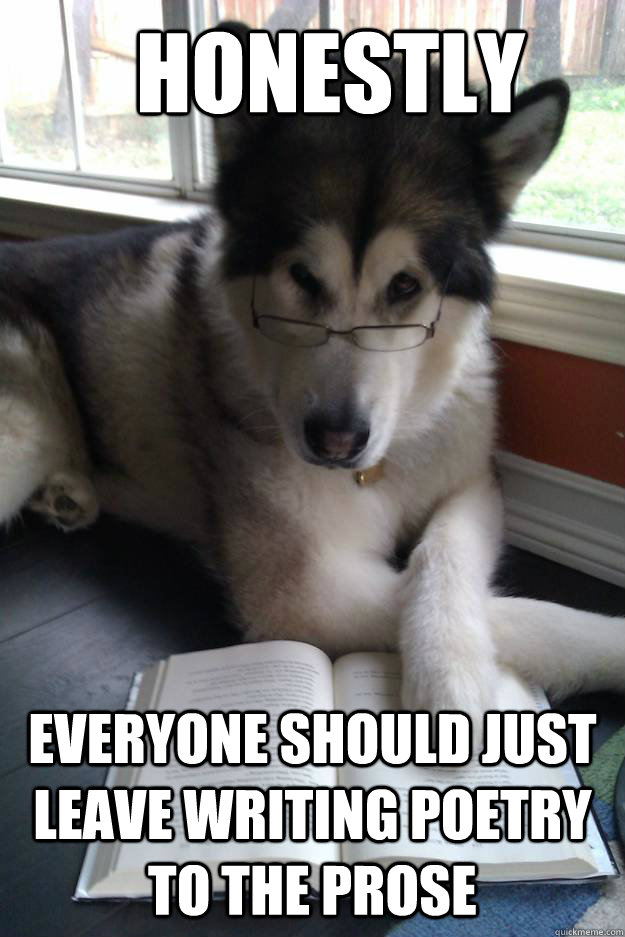
While I am an English major, poetry still eludes me at times. Despite this, I have decided to tackle the question, "What makes something 'poetry' rather than 'prose'?" as well as "Why is Beowulf poetry rather than prose?"

To start off with, here is an article from The Poetry Foundation that I found:
http://www.poetryfoundation.org/harriet/2012/04/the-difference-between-poetry-and-prose/
To highlight the key points that are relevant to us:


To start off with, here is an article from The Poetry Foundation that I found:
http://www.poetryfoundation.org/harriet/2012/04/the-difference-between-poetry-and-prose/
To highlight the key points that are relevant to us:
- Martin Earl - this Poetry Foundation blogger dude who says some really elusive and airy stuff (see, this is why people have issues with poetry) that sandwiches some comprehend-able stuff - states, "Poetry creates its own truth, which at times is the same truth as the world’s, and sometimes not." This, I believe, is the case with Beowulf; Beowulf is this sort of superhuman, for one thing, and this story is not exactly "historically accurate," so it is a truth - a constructed truth, not the truth. Any thoughts on this? Are there any elements within Beowulf that relate to our own "truths" today?
- Earl also states, "In both classical and modern languages it is poetry that evolves first and is only much later followed by prose, as though in a language’s childhood, as in our own, poetry were the more efficient communicator of ideas. Whether this has to do with the nature of ideation or some characteristic intrinsic to the material evolution of tongues has never been adequately decided." This directly answers the question as to why Beowulf is written in poetry. Beowulf, clearly, falls into this category of linguistic/literary evolution. More than that, though, think about songs that tell stories, or myths and stories that have been passed along for generations - isn't there a certain simplicity of the descriptions that can also be seen in Beowulf? Lengthy and/or descriptive titles of individuals; a sense of community and a common purpose or enemy; a definitive action taken? In this way, I think "poetry" may be our most long-standing form of story-telling.
What makes Beowulf poetry? It has short lines, all that awesome alliteration...anything else? The syntax is quite poetic-y.

How would Beowulf be different were it written like a novel? A graphic novel? Are there elements to the story that might be lost or altered?
Well, I tackled the questions, but I don't know how clean or effective of a tackle it was.
Here's another meme to conclude with:
Beowulf: Super Hero
We grow up our
entire lives looking up to someone; whether that is a parent or a story
character, we spend our childhoods striving to be like this person. Most little kids have some form of this and in many cases it was a fictional character with
extraordinary powers. Even as we get older people still ask who your "hero" is. For some people it's a literal super hero and for others it is someone they see as a super hero. Beowulf is the past equivalant to someone like superman. He is indestrucatble and capable of winning any battle. He is their hero who can survive through every thing, whether the problem is large or small. I think it’s important to have super heroes, I think they
give an escape and in many cases a hope even when things seem bleak. Everyone needs to believe there is
someone out there who can save them from the dangers of the world. In Beowulf he is that hope he shows them that it is never over, that the good side always prevails.
A super hero is steriotypes as a protector, a role model, and an overall good person; especially when we are
little we see them as perfect. We need them to help us believe that there is someone there trying to
fight the evil and protect us from the bad things lurking out in the world. I think it's a way for people to believe in something and hope for improvment in the world. The
idea that someone can fly and have extreme strength and the ability to survive
any attack is outlandish and adults know it's impossible, but it's useful especially to kids. Everybody has to face the inevitable that
we aren’t indestructible, we can get hurt and things can go wrong and in many
cases we don’t get some muscular man in tights that flies in and saves the day,
but super heroes give us that escape. They make us believe that things like that can happen. They show us that even when all hope is lost things can get
better; they show us that good wins in the end.
Beowulf is this super hero for the Danes. While he doesn't come flying in wearing tights, he does come sailing in after twelve
years of turmoil to save them from the awful monster that has been terrorizing
them. He is their hope when they can’t come up with any other ways to stop the
monster. All odds are stacked against him; the most ferocious warriors were
slaughtered at the hands of this creature, and then comes a man who is willing
to risk his life to end their problems. He has completed amazing feats of strength, even before battling Grendel, that no normal person could ever manage. Beowulf is capable of fighting off sea monsters after swimming for days, and fighting two ferocious monsters with just his bare hands. He is so powerful he rips off the arm of a Grendel, that no sword could cut. Beowulf is the Danes super hero because he can attempt and complete these insane tasks that all before had failed at. While these powers are different than modern super hero's powers they still represent the same idea of good beating evil in the end. Beowulf is a story of this man with amazing skills who has God on his side and this makes him capable of amazing things. So in reality super heroes were just as important when Beowulf was first told as they are now, they are our hope for a better future where good always wins.
Monday, August 31, 2015
Beowulf, Hercules, and More Heroes
Go Team Satire! And I don't mean that in a satirical way, I mean it (oh, the corniness). Before I begin with the main topic of my blog, I'd like to give a little backstory as to what Beowulf means to me. This isn't necessarily a diary, I know, but if we are all to know each other well...to know this is to better know me.
My grandfather was called Papa. No, not Pah-Pah like in fairy tales, Pah-Pah! (With the exclamation point.)
Imagine a group of mobsters greeting their father over a dinner feast. That's the kind of Pah-Pah! he wanted to be.
Papa loved stories, and he knew them all. Every constellation was a story of an adventure yet to be told, every dusty old book a doorway to the past just waiting to be opened. And he opened them for me! He gave me my first copy of Beowulf when I was ten. It was a worn old thing, but I loved it. I never read it and he knew it (because let's be real, I couldn't comprehend that particular edition now) so he told it to me.
He told me his version of Beowulf...
which means I know nothing abut what actually happened.
But I know some version, that is half-true and half made-up by him.
Papa passed away this past summer. He was my best friend,
But I'll always have in my heart the best version of Beowulf EVER.
I suppose you're wanting me to "get on with it!" Goodness I love Monty Python (so I will post a segment from one of their movies to cheer up this vibe a little).
Papa was, and IS, my hero. Like King Arthur, or maybe even Beowulf, he is gone but forever here. Papa had his own qualities that made him my hero, as did Beowulf for other people. Let's look at a few of Beowulf's qualities that made him admirable to the readers of the time (I just realized I'm assuming that Beowulf is nobody's hero anymore. Maybe he's yours. If so, comment! Anyway...getting ON with it):
Beowulf is...
Brave
Charismatic
Impressive to look at
Quick on his feet
Has...super-human powers?
Did you catch anything else?
It's interesting to me that Beowulf isn't just, well...a piece of meat. He isn't like Hercules in the ancient Greek legend, who is actually described as the equivalent of a dumb jock, and was actually a pawn during Hera's vengeful wrath.
Oh...Hercules. How you fall for things.
...Do you like Beowulf as a person at all?
Let me know what you think! And of course, happy reading!
My grandfather was called Papa. No, not Pah-Pah like in fairy tales, Pah-Pah! (With the exclamation point.)
Imagine a group of mobsters greeting their father over a dinner feast. That's the kind of Pah-Pah! he wanted to be.
Papa loved stories, and he knew them all. Every constellation was a story of an adventure yet to be told, every dusty old book a doorway to the past just waiting to be opened. And he opened them for me! He gave me my first copy of Beowulf when I was ten. It was a worn old thing, but I loved it. I never read it and he knew it (because let's be real, I couldn't comprehend that particular edition now) so he told it to me.
He told me his version of Beowulf...
which means I know nothing abut what actually happened.
But I know some version, that is half-true and half made-up by him.
Papa passed away this past summer. He was my best friend,
But I'll always have in my heart the best version of Beowulf EVER.
I suppose you're wanting me to "get on with it!" Goodness I love Monty Python (so I will post a segment from one of their movies to cheer up this vibe a little).
Papa was, and IS, my hero. Like King Arthur, or maybe even Beowulf, he is gone but forever here. Papa had his own qualities that made him my hero, as did Beowulf for other people. Let's look at a few of Beowulf's qualities that made him admirable to the readers of the time (I just realized I'm assuming that Beowulf is nobody's hero anymore. Maybe he's yours. If so, comment! Anyway...getting ON with it):
Beowulf is...
Brave
Charismatic
Impressive to look at
Quick on his feet
Has...super-human powers?
Did you catch anything else?
It's interesting to me that Beowulf isn't just, well...a piece of meat. He isn't like Hercules in the ancient Greek legend, who is actually described as the equivalent of a dumb jock, and was actually a pawn during Hera's vengeful wrath.
Beowulf is charismatic, he is cunning, and overall, he seems fairly intelligent. Do you think this is significant? Do you think this says something about the culture of the time? Does it make you like Beowulf more?
...Do you like Beowulf as a person at all?
Let me know what you think! And of course, happy reading!
Subscribe to:
Posts (Atom)